robustcov documentation
Why robustcov?
Many machine-learning workflows use covariance geometry implicitly: anomaly scores, whitening, Mahalanobis distances, kernel similarities, Gaussian models, portfolio risk, and embedding retrieval. Empirical covariance is fast and useful, but it can be strongly distorted by outliers, heavy tails, leverage points, and small contaminated subsets of the data.
robustcov provides robust covariance and scatter estimators together with
practical machine-learning workflows around them: anomaly detection,
diagnostics, benchmark galleries, robust kernel/input metrics, and SPD geometry
utilities.
The typical workflow is:
contaminated data
     -> robust scatter estimate
     -> robust precision / Mahalanobis geometry
     -> anomaly score, whitening, similarity, kernel, or diagnostic
When should I use this?
Use robustcov when covariance geometry matters and the data may contain
outliers, heavy tails, small contaminated subsets, leverage points, or unstable
directions. Typical use cases include tabular anomaly detection, sensor
monitoring, financial features, embeddings, robust preprocessing, and kernel
methods.
Project status
robustcov is under active development. The implemented estimators, examples,
and diagnostics are tested and documented, but some APIs may evolve as the
package matures. See API stability for the current stability policy.
robustcov is an experimental robust covariance, heavy-tail scatter, anomaly diagnostics, and benchmark-gallery package with a C++/pybind core.
The project is organized around two reader-friendly entry points:
gallery
Start from your application
Topic-based gallery: finance/risk, fraud/security, sensors/quality, biomedical/images/embeddings, real ML datasets, and preprocessing.
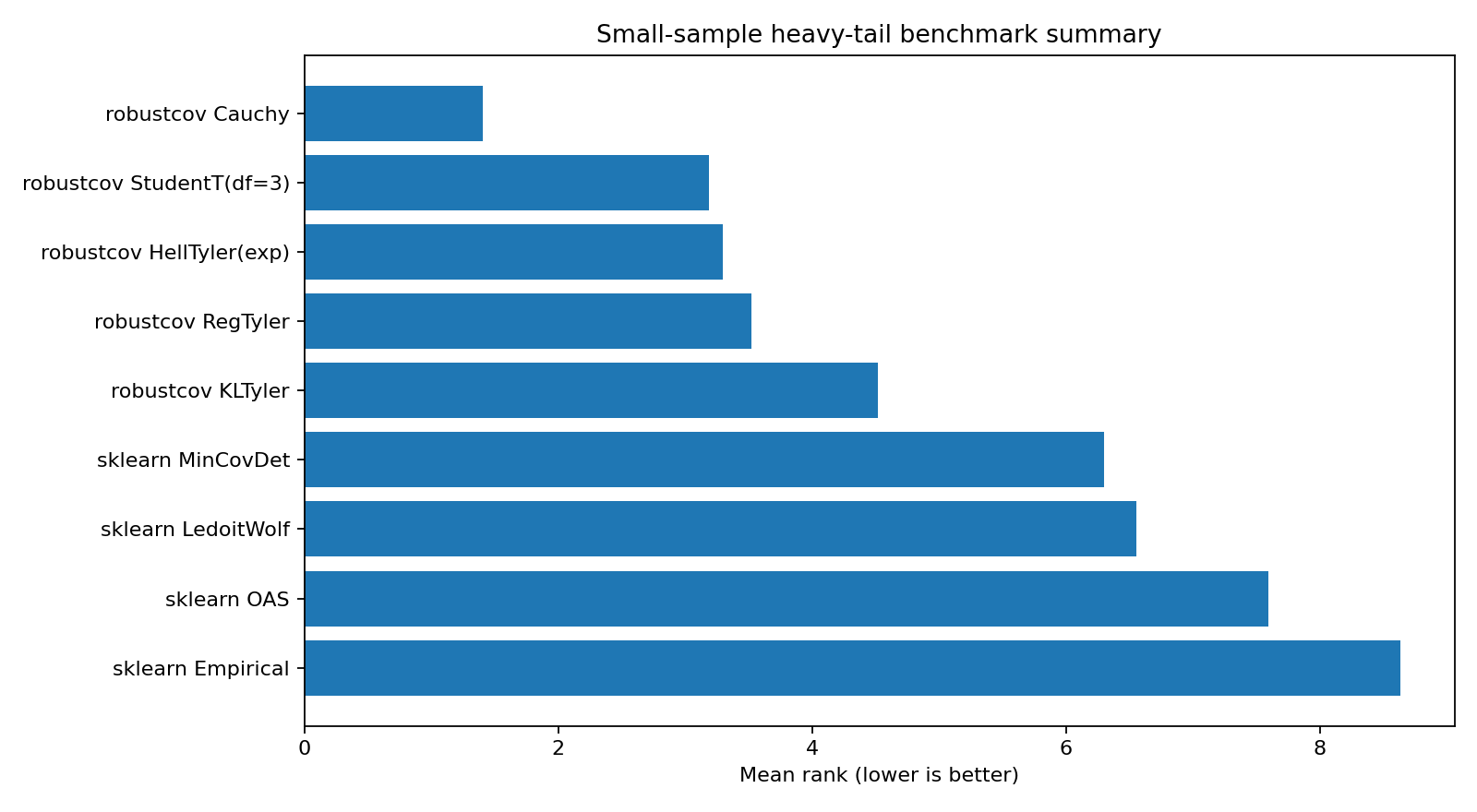
Start from the evidence
Small-sample heavy-tail ranking, speed comparisons, OpenMP scaling, anomaly baselines, and hard contamination scenarios.
and API
Understand the estimators
FastMCD, Tyler shape, Regularized Tyler, Student-t scatter, Cauchy scatter, diagnostics, and references.
Core ideas
FastMCDgives efficient classical robust covariance for separable contamination whennis comfortably larger thanp.RegularizedCauchyandStudentTScattertarget small-sample, high-dimensional, heavy-tailed covariance problems.Robust-distance diagnostics turn fitted estimators into interpretable anomaly scores, profiles, QQ plots, and reports.
Optional OpenMP acceleration improves larger workloads and benchmark/report generation.
User guide
Reference and evidence
Why not focus on MVE?
Minimum-volume ellipsoid estimators are historically important, but the benchmark evidence in this project points to a stronger niche: efficient MCD for separable outliers and regularized heavy-tail scatter for small samples. MVE may become an experimental add-on later, but it is not currently the core differentiator.