Credit-card fraud result
Why this result matters
Credit-card fraud is a popular imbalanced anomaly-detection benchmark. It is a useful public example because users already understand the task, and because PR AUC and F1 are more informative than accuracy on rare fraud events.
Observed result
A local external run reported the following table.
Method |
Seconds |
Precision |
Recall |
F1 |
ROC AUC |
PR AUC |
|---|---|---|---|---|---|---|
robustcov FastMCD |
57.202 |
0.801 |
0.801 |
0.801 |
0.957 |
0.712 |
sklearn IsolationForest |
3.392 |
0.262 |
0.262 |
0.262 |
0.948 |
0.143 |
sklearn EllipticEnvelope |
12.518 |
0.213 |
0.213 |
0.213 |
0.920 |
0.125 |
sklearn LocalOutlierFactor |
35.981 |
0.000 |
0.000 |
0.000 |
0.513 |
0.002 |
Plots
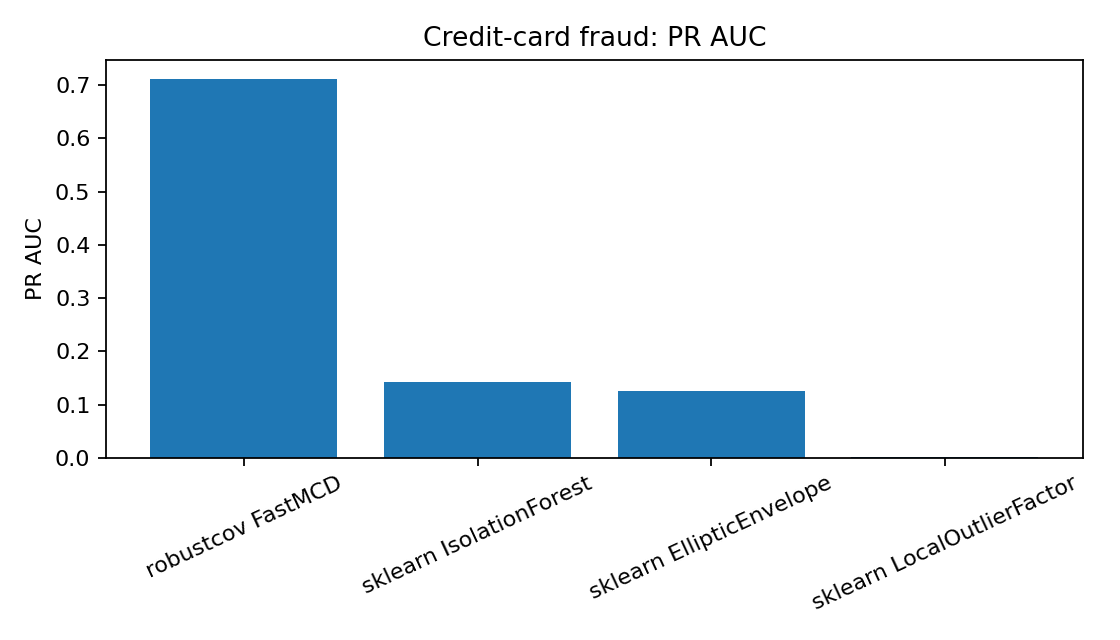
PR-AUC comparison. This metric is important for rare fraud because it focuses on precision/recall behavior under severe class imbalance.
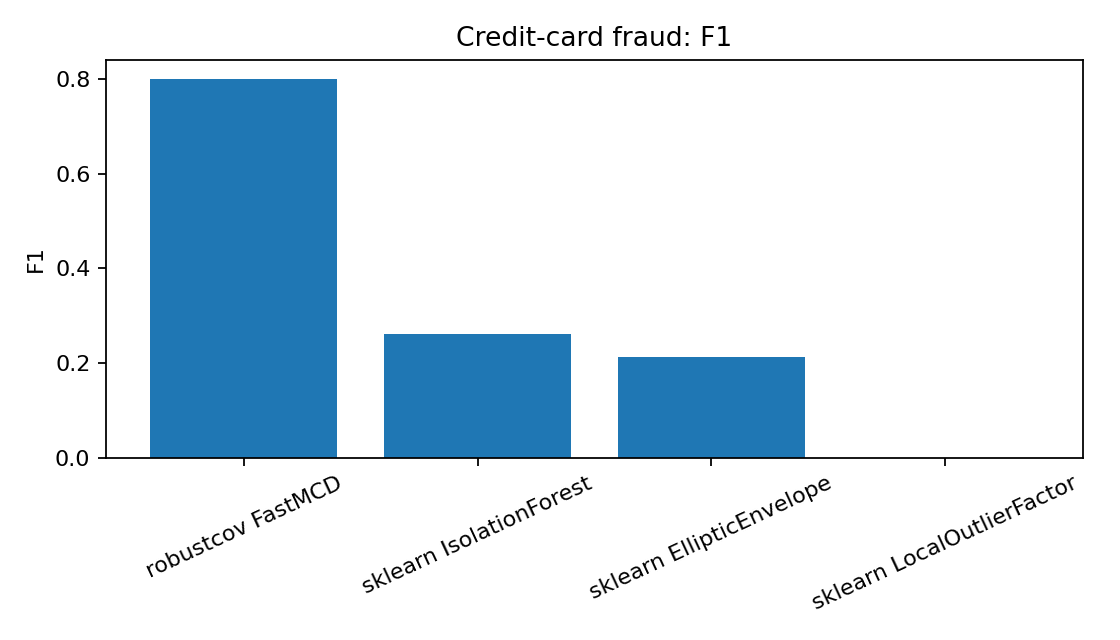
Thresholded F1 comparison at the same detected-count level.
Output from the run
method,seconds,precision,recall,f1,roc_auc,pr_auc,detected
robustcov FastMCD,57.2020,0.8008,0.8008,0.8008,0.9573,0.7121,492
sklearn IsolationForest,3.3915,0.2622,0.2622,0.2622,0.9475,0.1427,492
sklearn EllipticEnvelope,12.5178,0.2134,0.2134,0.2134,0.9199,0.1248,492
sklearn LocalOutlierFactor,35.9812,0.0000,0.0000,0.0000,0.5127,0.0021,492
saved outputs to results/external/credit_card_fraud
Interpretation
robustcov FastMCD was slower than IsolationForest in this run, but it
produced a much stronger thresholded fraud-screening result and a much higher
PR AUC. This is a good Kaggle/notebook story because the robust-distance score
is interpretable and the metric gap is large.
How to reproduce
Download the credit-card fraud CSV manually, then run:
python examples_external/kaggle_credit_card_fraud.py \
  --data /path/to/creditcard.csv \
  --outdir results/external/credit_card_fraud
Outputs
The script writes:
metrics.csv;pr_auc.png;f1.png;robust_score_profile.png;summary.md.
Production note
This should be presented as an unsupervised screening score, not as a full competition-winning fraud pipeline. In supervised Kaggle settings, the robust score can also be used as a feature for gradient boosting or other classifiers.