Contents Menu Expand Light mode Dark mode Auto light/dark, in light mode Auto light/dark, in dark mode Skip to content
robustcov 0.0.1 documentation

User guide

  • Installation
  • Quickstart
  • Estimator guide
  • Use-case gallery
    • Finance and risk
      • Finance-style heavy-tail covariance
      • Portfolio covariance stress comparison
    • Fraud, security, and network anomalies
      • Fraud-style tabular anomaly screening
      • Network-traffic anomaly simulation
    • Sensors, industrial monitoring, and quality control
      • Sensor anomaly detection
      • Predictive-maintenance monitoring
      • Quality-control monitoring
    • Biomedical, image, and embedding data
      • Biomedical / signal-window anomaly detection
      • Image-feature one-class anomaly detection
      • Text / embedding outlier screening
    • Real ML datasets
      • Breast-cancer screening as anomaly ranking
      • Digits one-class anomaly detection
      • Wine class screening
      • Multimodal anomaly detection
    • Robust ML preprocessing
      • Robust preprocessing before classification
    • Finance-style heavy-tail covariance
    • Portfolio covariance stress comparison
    • Fraud-style tabular anomaly screening
    • Network-traffic anomaly simulation
    • Sensor anomaly detection
    • Predictive-maintenance monitoring
    • Quality-control monitoring
    • Biomedical / signal-window anomaly detection
    • Image-feature one-class anomaly detection
    • Text / embedding outlier screening
    • Breast-cancer screening as anomaly ranking
    • Digits one-class anomaly detection
    • Wine class screening
    • Robust preprocessing before classification
    • Multimodal anomaly detection
  • Benchmark gallery
    • Small-sample heavy-tail benchmark
    • Speed comparison
    • OpenMP scaling benchmark
    • Anomaly detection baselines
    • Hard contamination scenarios
  • Algorithms
  • Diagnostics
  • Optional OpenMP acceleration
  • FAQ

Reference and evidence

  • API reference
  • API stability
  • Robust statistics background
  • External and Kaggle gallery
    • Credit-card fraud result
    • Predictive maintenance
    • IEEE-CIS fraud
    • Medical screening
    • Finance market-stress anomaly detection
    • Rolling-window finance anomaly detection
  • References

Extended material

  • Notebooks
  • Kaggle and external dataset roadmap
  • Kaggle and external examples
  • External demo workflow
  • Project readiness notes
Back to top
View this page

Benchmark gallery

The benchmark gallery is the main benchmark entry point. It is designed for readers who want to understand the evidence quickly: each card links to a focused benchmark page with plots, tables, commands, and interpretation.

The gallery answers four practical questions:

  • Which estimator works best for small-sample heavy-tailed covariance?

  • How much faster is robustcov than common sklearn robust-covariance baselines?

  • Does optional OpenMP parallelism help at larger scale?

  • Where do robust covariance methods work well, and where do they fail?

Gallery cards
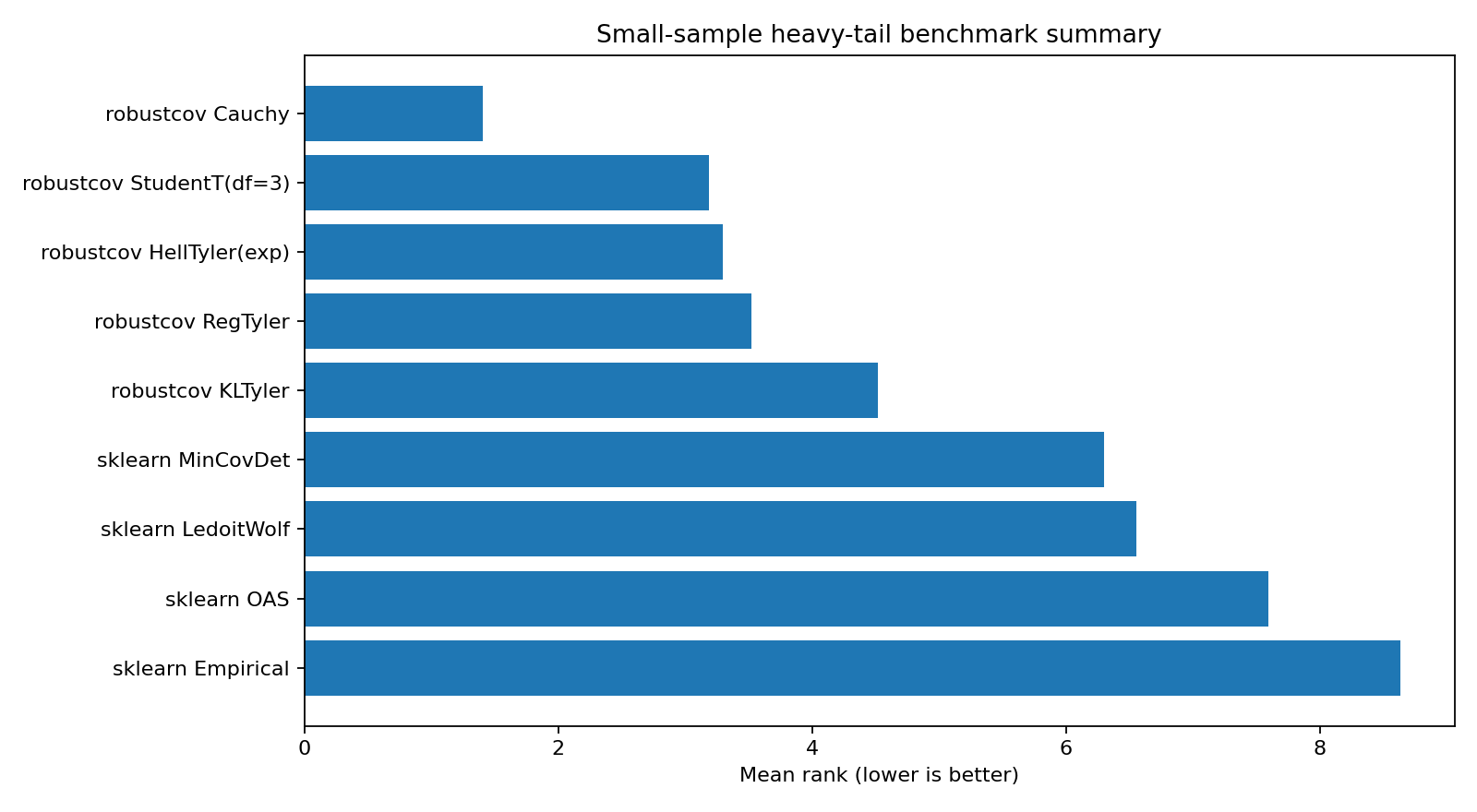
Small-sample heavy-tail ranking

Small-sample heavy-tail ranking

Regularized Cauchy, Student-t scatter, Tyler variants, MCD, Ledoit-Wolf, OAS, and empirical covariance compared across n, p, and tail weight.
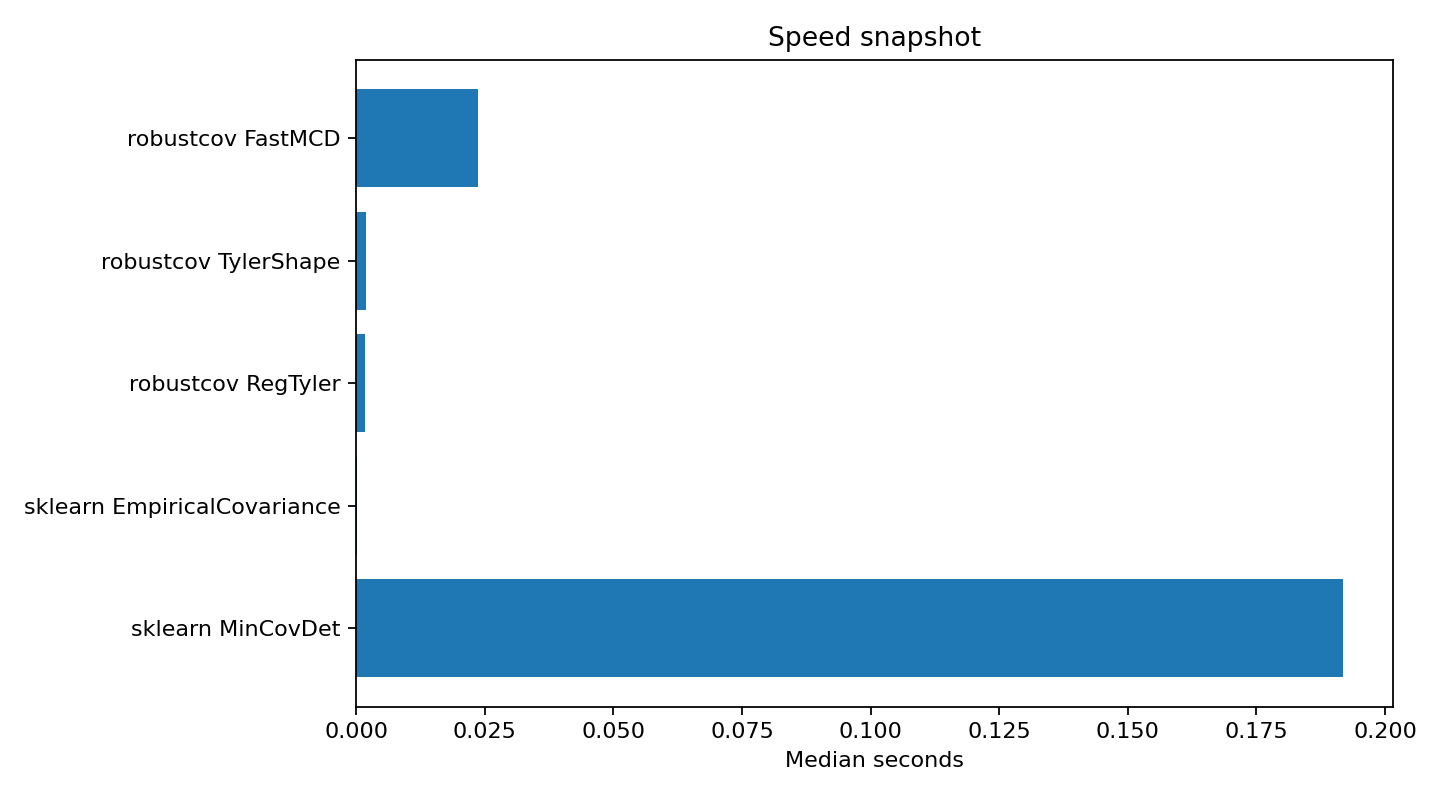
Speed comparison

Speed comparison

FastMCD and Tyler-family timing against sklearn covariance baselines in a representative contamination setting.
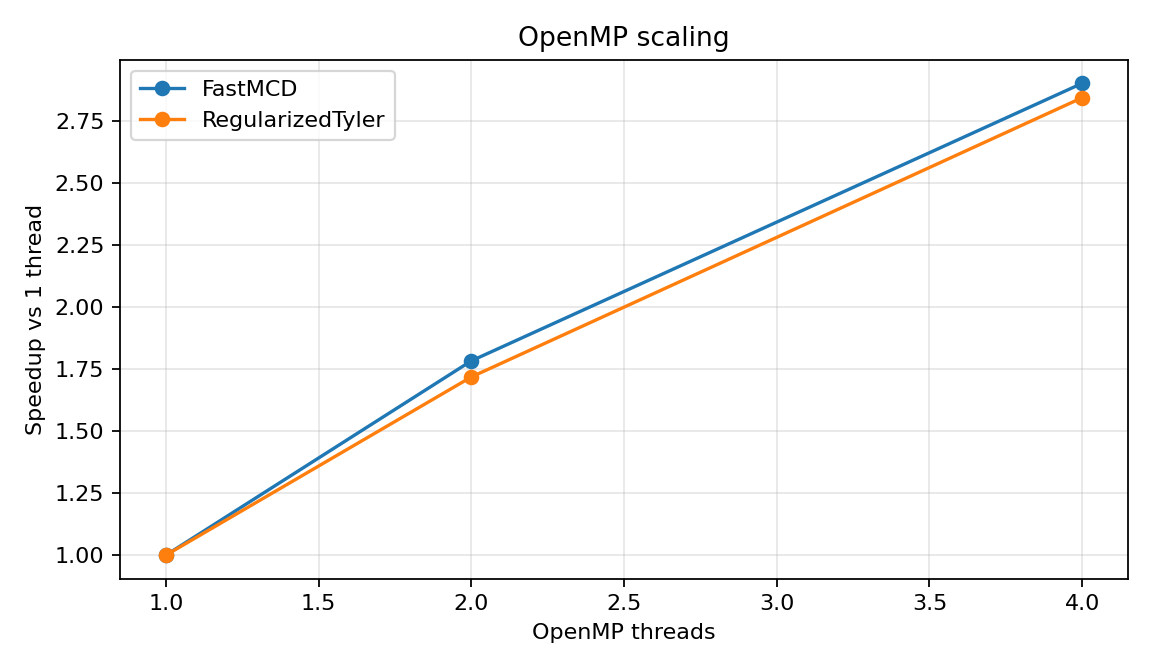
OpenMP scaling

OpenMP scaling

Thread scaling for the C++ kernels used by FastMCD and RegularizedTyler.
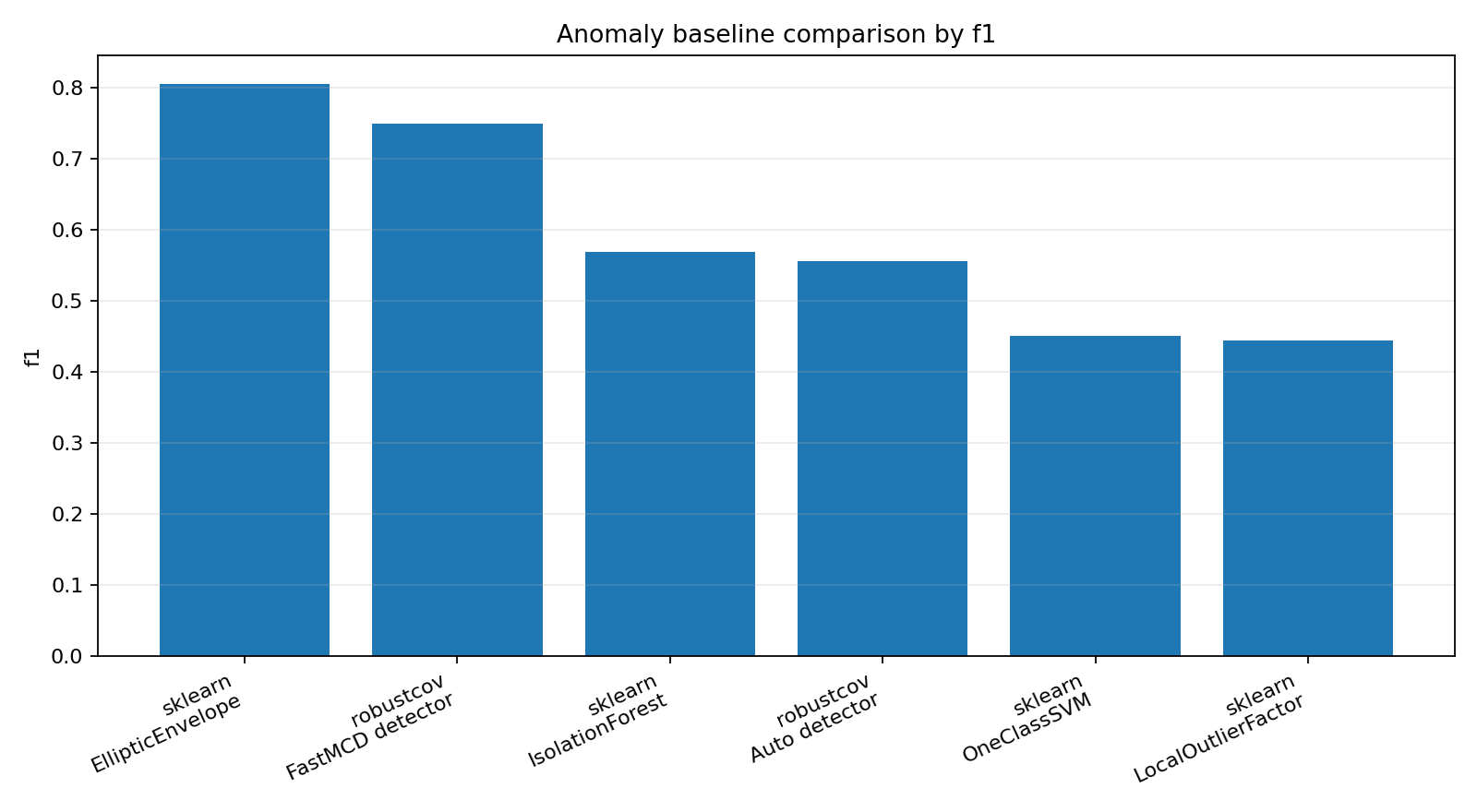
Anomaly baseline comparison

Anomaly detection baselines

Robust distance detectors compared with IsolationForest, LOF, OneClassSVM, and EllipticEnvelope.

Hard
scenarios

Hard contamination scenarios

Mean shift, clustered contamination, variance contamination, leverage points, and heavy-tail inliers.

Recommended benchmark workflow

Run the full report generator when you want the same assets used by the documentation:

OMP_NUM_THREADS=4 OPENBLAS_NUM_THREADS=1 MKL_NUM_THREADS=1 \
python benchmarks/make_report.py --outdir results/report

This writes a standalone HTML report, Markdown report, CSV files, and plots.

results/report/benchmark_report.html
results/report/benchmark_report.md
results/report/small_sample.csv
results/report/small_sample_summary.csv
results/report/small_sample_rank.png
results/report/speed.csv
results/report/speed.png
results/report/openmp_scaling.csv
results/report/openmp_scaling.png
results/report/anomaly_baselines.csv
results/report/anomaly_baselines.png
results/report/hard_scenarios.csv

How to read the gallery

A single benchmark row is rarely enough. Prefer rank summaries, median error, win rate, and scenario-specific interpretation. RegularizedCauchy is usually the strongest small-sample heavy-tail covariance estimator. FastMCD is the classical choice for separable contamination when the uncontaminated majority is well defined. RegularizedTyler is best described as a robust shape estimator and should not be advertised as the universal covariance-recovery winner.

Detailed benchmark pages

Next
Small-sample heavy-tail benchmark
Previous
Robust preprocessing before classification
Copyright ©
Made with Sphinx and @pradyunsg's Furo
On this page
  • Benchmark gallery
    • Gallery cards
    • Recommended benchmark workflow
    • How to read the gallery
    • Detailed benchmark pages