Robust preprocessing before classification
Sometimes robust covariance is not the final model. It can be a preprocessing step that identifies suspicious training rows before fitting a standard classifier.
Result at a glance
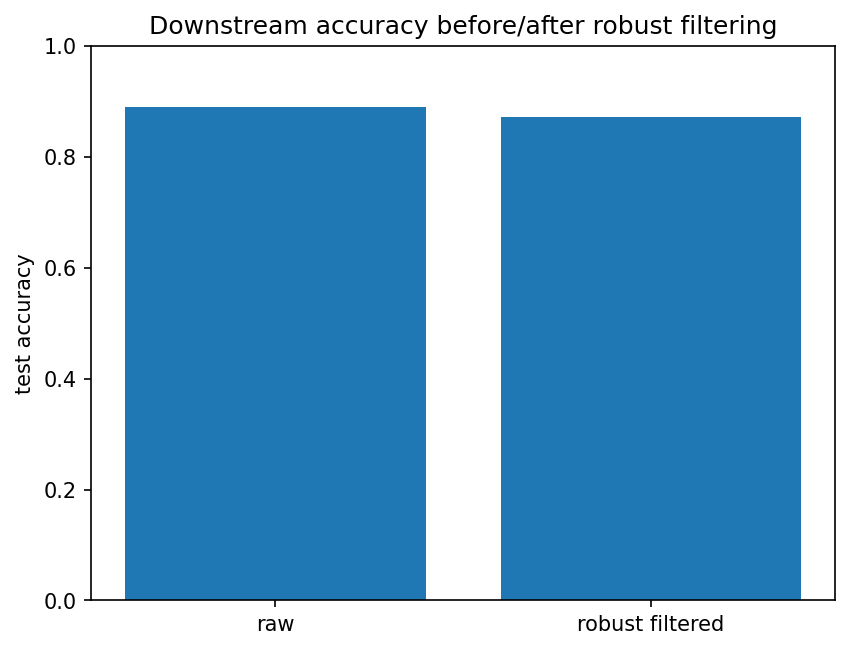
In this run, filtering removes 39 training rows. The filtered classifier is slightly worse than the raw classifier, which is an important honest result: robust filtering is not automatically beneficial.
What the data represent
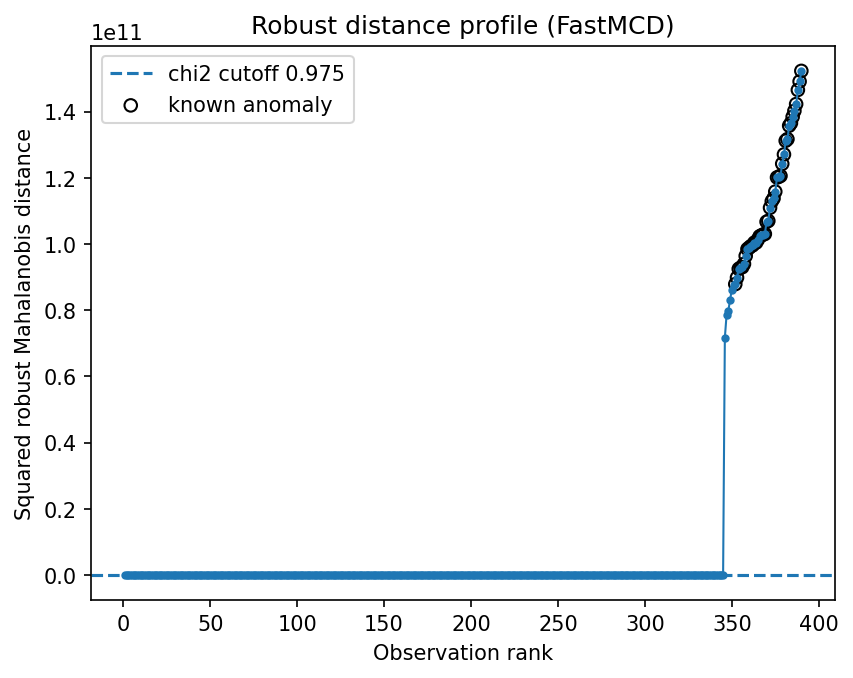
The example uses a noisy supervised classification problem. robustcov scores are computed on the training features and high-distance rows are removed before refitting the classifier.
Why this estimator
RegularizedCauchy or AutoRobustScatter is useful when the training set may contain heavy-tailed contamination. The goal is not to win every classifier benchmark, but to diagnose influential or suspicious rows.
Reproduce the result
python examples/use_case_ml_preprocessing.py
Output from the run
robust preprocessing for downstream ML
raw_training_accuracy_on_test=0.890
robust_filtered_accuracy_on_test=0.871
removed_training_rows=39
scatter_radial_kurtosis=6883710114330931200.000
saved diagnostics to results/use_cases/ml_preprocessing
Figures and diagnostics
How to read the result
Compare the accuracy plot before and after filtering. If performance drops, the removed rows may be hard-but-valid training examples rather than harmful contamination.
What this does not prove
Use this workflow with cross-validation. Never filter using test labels, and do not assume that every outlier is an error.