Robust embedding retrieval / RAG filtering
Modern retrieval and RAG systems often use embedding similarity to rank candidate documents. Cosine similarity is a strong default, but embedding spaces can contain anisotropic or leverage-like directions. A small number of abnormal directions can distort nearest-neighbor rankings.
This example uses the real 20 Newsgroups text dataset. Documents are embedded with TF-IDF followed by truncated SVD. A controlled leverage-like artifact is then injected into part of the reference embedding set.
The experiment compares:
clean cosine retrieval;
contaminated cosine retrieval;
cosine retrieval with robust leverage filtering.
The goal is not to replace semantic embedding models. The goal is to show how robust covariance geometry can act as a second-stage filter when embedding directions contain leverage-like artifacts.
Retrieval pattern
This example demonstrates a practical retrieval pattern:
use a standard semantic retriever to get candidates;
fit a robust scatter model on the reference embeddings;
identify leverage-like candidates under the robust geometry;
filter those candidates;
rank the remaining candidates by cosine similarity.
Run the example
python examples/embedding_reranking_robust_geometry.py
Output
Robust embedding retrieval / RAG-style filtering
================================================

Dataset: 20 Newsgroups
Embedding: TF-IDF + TruncatedSVD(32)
Reference documents: 850
Query documents: 250
Injected leverage-like reference embeddings: 85

Robust leverage filter
filtered reference fraction:              0.200
injected artifacts filtered:              1.000
ordinary references filtered:             0.111

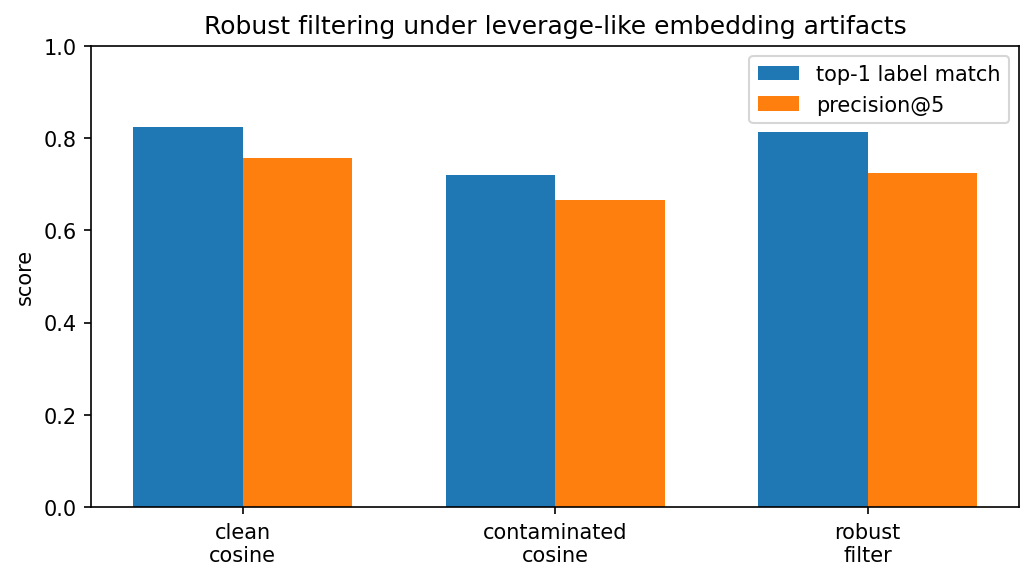
Retrieval quality
method                            top1_label_match   precision_at_5
clean cosine                               0.824           0.757
contaminated cosine                        0.720           0.665
robust leverage filter                     0.812           0.724

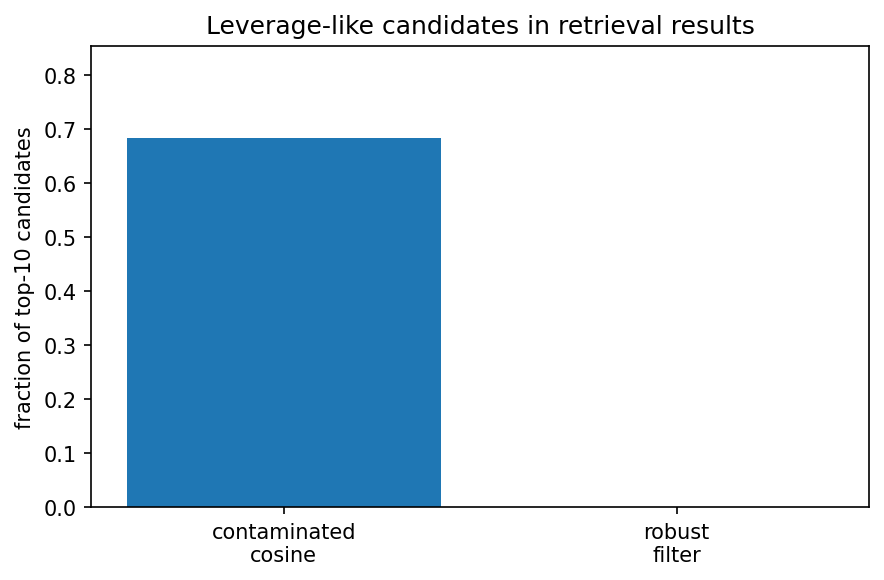
Leverage-like candidates in top-10
contaminated cosine:                       0.683
robust leverage filter:                    0.000
Interpretation
In this run, the leverage artifact substantially harms contaminated cosine retrieval. The robust leverage filter removes all injected artifact references while filtering only a smaller fraction of ordinary references. As a result, retrieval quality moves back toward the clean-cosine baseline and the fraction of leverage-like candidates in the top-10 drops to zero.
Visual summary
Why geometry helps
A robust scatter estimate defines a robust precision matrix. Given a reference
embedding x and robust location mu, the robust leverage score is
Large values indicate candidates that are unusual under the robust reference geometry. In this example, those candidates are filtered after first-stage cosine retrieval.
This pattern is useful when embedding coordinates contain outlier directions, batch artifacts, sensor-like faults, or heavy-tailed variation. It is especially relevant for RAG-style systems, multimodal retrieval, and embedding search.
Source excerpt
fetch_20newsgroups, TruncatedSVD, TfidfVectorizer, normalize = _require_sklearn()

rng = np.random.default_rng(11)
outdir = Path("results/examples/embedding_reranking_robust_geometry")
outdir.mkdir(parents=True, exist_ok=True)

categories = [
    "comp.graphics",
    "rec.autos",
    "sci.space",
    "talk.politics.misc",
]

try:
    data = fetch_20newsgroups(
        subset="train",
        categories=categories,
        remove=("headers", "footers", "quotes"),
    )
except Exception as exc:  # pragma: no cover
    raise SystemExit(
        "Could not load the 20 Newsgroups dataset. This example needs "
        "scikit-learn's dataset cache or network access for the first run."
    ) from exc

texts = np.asarray(data.data)
labels = np.asarray(data.target)

keep = np.asarray([len(t.strip()) > 100 for t in texts])
texts = texts[keep]
labels = labels[keep]

idx = rng.permutation(len(texts))[:1200]
texts = texts[idx]
labels = labels[idx]

vectorizer = TfidfVectorizer(
    stop_words="english",
    min_df=2,
    max_features=6000,
)
X_sparse = vectorizer.fit_transform(texts)

svd = TruncatedSVD(n_components=32, random_state=0)
X = svd.fit_transform(X_sparse)

X = X - X.mean(axis=0)
X = X / (X.std(axis=0) + 1e-8)

n_ref = 850
n_query = 250

X_ref_clean = X[:n_ref]
y_ref = labels[:n_ref]

X_query = X[n_ref : n_ref + n_query]
y_query = labels[n_ref : n_ref + n_query]

# ------------------------------------------------------------------
# Controlled leverage-like embedding artifact.
#
# We append a nuisance coordinate. It is present in all queries and in a
# contaminated subset of reference embeddings. This mimics a batch,
# boilerplate, sensor, or embedding-pipeline artifact that can influence
# cosine similarity even though it is not semantic.
# ------------------------------------------------------------------
artifact_strength = 3.5
artifact_noise = 0.03

X_ref_cont = np.column_stack(
    [
        X_ref_clean,
        rng.normal(0.0, artifact_noise, size=n_ref),
    ]
)

X_query_cont = np.column_stack(
    [
        X_query,
        artifact_strength
        + rng.normal(0.0, artifact_noise, size=X_query.shape[0]),
    ]
)

leverage_mask = np.zeros(n_ref, dtype=bool)
n_bad = int(0.10 * n_ref)
bad_idx = rng.choice(n_ref, size=n_bad, replace=False)
leverage_mask[bad_idx] = True

X_ref_cont[bad_idx, -1] = artifact_strength + rng.normal(
    0.0, artifact_noise, size=n_bad
)

# Cosine baselines use normalized embeddings.
X_ref_clean_cos = normalize(X_ref_clean)
X_query_clean_cos = normalize(X_query)

X_ref_cont_cos = normalize(X_ref_cont)
X_query_cont_cos = normalize(X_query_cont)

clean_top1, clean_p5, _ = evaluate_cosine(
    X_ref_clean_cos,
    y_ref,
    X_query_clean_cos,
    y_query,
)

cont_top1, cont_p5, cont_order = evaluate_cosine(
    X_ref_cont_cos,
    y_ref,
    X_query_cont_cos,
    y_query,
)

# Robust geometry fitted on contaminated reference embeddings.
fit = rc.FastMCD(
    contamination=0.20,
    quality="high",
    random_state=0,
).fit(X_ref_cont)

leverage = robust_leverage_scores(
    X_ref_raw=X_ref_cont,
    location=fit.location_,
    precision=fit.precision_,
)

# Use robust geometry as a filter: remove the highest-leverage 10% of the
# reference set. In real workflows this threshold is a validation parameter.
leverage_cutoff = np.quantile(leverage, 0.80)
keep_mask = leverage <= leverage_cutoff

robust_top1, robust_p5, robust_order = evaluate_robust_leverage_filter(
    X_ref_cos=X_ref_cont_cos,
    y_ref=y_ref,
    X_query_cos=X_query_cont_cos,
    y_query=y_query,
    first_stage_order=cont_order,
    leverage=leverage,
    keep_mask=keep_mask,
    candidate_k=150,
    top_k=5,
)

cont_lev10 = leverage_fraction(cont_order, leverage_mask, k=10)
robust_lev10 = leverage_fraction(robust_order, leverage_mask, k=10)

detected_bad = float(np.mean(~keep_mask[leverage_mask]))
false_filtered = float(np.mean(~keep_mask[~leverage_mask]))

print("Robust embedding retrieval / RAG-style filtering")
print("================================================")
print()
print("Dataset: 20 Newsgroups")
print("Embedding: TF-IDF + TruncatedSVD(32)")
print("Reference documents:", n_ref)
print("Query documents:", n_query)
print("Injected leverage-like reference embeddings:", n_bad)
print()
print("Robust leverage filter")
print("filtered reference fraction:          ", f"{np.mean(~keep_mask):8.3f}")
print("injected artifacts filtered:          ", f"{detected_bad:8.3f}")
print("ordinary references filtered:         ", f"{false_filtered:8.3f}")
print()
print("Retrieval quality")
print("method                            top1_label_match   precision_at_5")
print(f"clean cosine                            {clean_top1:8.3f}        {clean_p5:8.3f}")
print(f"contaminated cosine                     {cont_top1:8.3f}        {cont_p5:8.3f}")
print(f"robust leverage filter                  {robust_top1:8.3f}        {robust_p5:8.3f}")
print()
print("Leverage-like candidates in top-10")
print(f"contaminated cosine:                    {cont_lev10:8.3f}")
print(f"robust leverage filter:                 {robust_lev10:8.3f}")

try:
    import matplotlib.pyplot as plt
except Exception:
    return

labels_plot = ["clean\ncosine", "contaminated\ncosine", "robust\nfilter"]
top1_values = [clean_top1, cont_top1, robust_top1]
p5_values = [clean_p5, cont_p5, robust_p5]

x = np.arange(len(labels_plot))
width = 0.35

fig = plt.figure(figsize=(7, 4))
ax = fig.add_subplot(111)
ax.bar(x - width / 2, top1_values, width, label="top-1 label match")
ax.bar(x + width / 2, p5_values, width, label="precision@5")
ax.set_xticks(x)
ax.set_xticklabels(labels_plot)
ax.set_ylim(0.0, 1.0)
ax.set_ylabel("score")
ax.set_title("Robust filtering under leverage-like embedding artifacts")
ax.legend()
fig.tight_layout()
fig.savefig(outdir / "embedding_reranking_quality.png", dpi=150, bbox_inches="tight")
plt.close(fig)

fig = plt.figure(figsize=(6, 4))
ax = fig.add_subplot(111)
ax.bar(
    ["contaminated\ncosine", "robust\nfilter"],
    [cont_lev10, robust_lev10],
)
ax.set_ylim(0.0, max(cont_lev10, robust_lev10, 1e-6) * 1.25)
ax.set_ylabel("fraction of top-10 candidates")
ax.set_title("Leverage-like candidates in retrieval results")
fig.tight_layout()
fig.savefig(outdir / "embedding_reranking_leverage.png", dpi=150, bbox_inches="tight")
plt.close(fig)