Image-feature one-class anomaly detection
This example uses image-derived features rather than raw pixels. The question is whether robust distances can flag images from a different class when trained on a single normal class.
Result at a glance
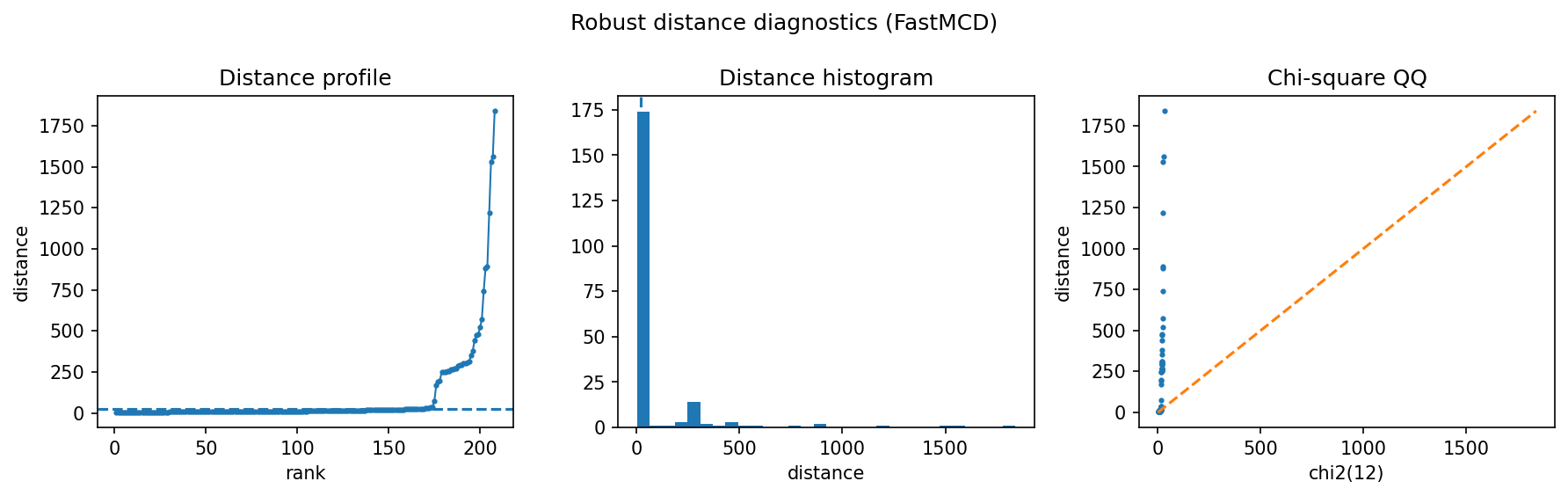
For the digits setup, robust distances detect 90% of the anomaly digit at the fixed detection budget. The radial kurtosis is high, which is common when image features contain a small separated class.
What the data represent
The example uses sklearn digits features after dimensionality reduction/feature extraction. One digit is treated as normal and another as the anomaly class.
Why this estimator
FastMCD is a good baseline for one-class feature vectors when the normal class is compact. For multiple normal styles, use the multimodal detector.
Reproduce the result
python examples/use_case_image_feature_anomaly.py
Output from the run
image-feature one-class anomaly example
normal_digit=0, anomaly_digit=1, anomaly_count=30, n=208, p=12
precision=0.900, recall=0.900, detected=30
radial_kurtosis=120.197
saved diagnostics to results/use_cases/image_features
Figures and diagnostics
How to read the result
The distance panel should show whether anomaly images occupy the high-distance tail. If errors concentrate in ambiguous images, the robust score can still be useful as a review priority.
What this does not prove
For modern image anomaly detection, deep embeddings are usually better than raw low-dimensional features. robustcov is most useful after feature extraction.