Biomedical / signal-window anomaly detection
Signal-window features often have correlated energy and shape descriptors. Robust covariance gives a compact way to screen windows whose joint feature pattern is abnormal.
Result at a glance
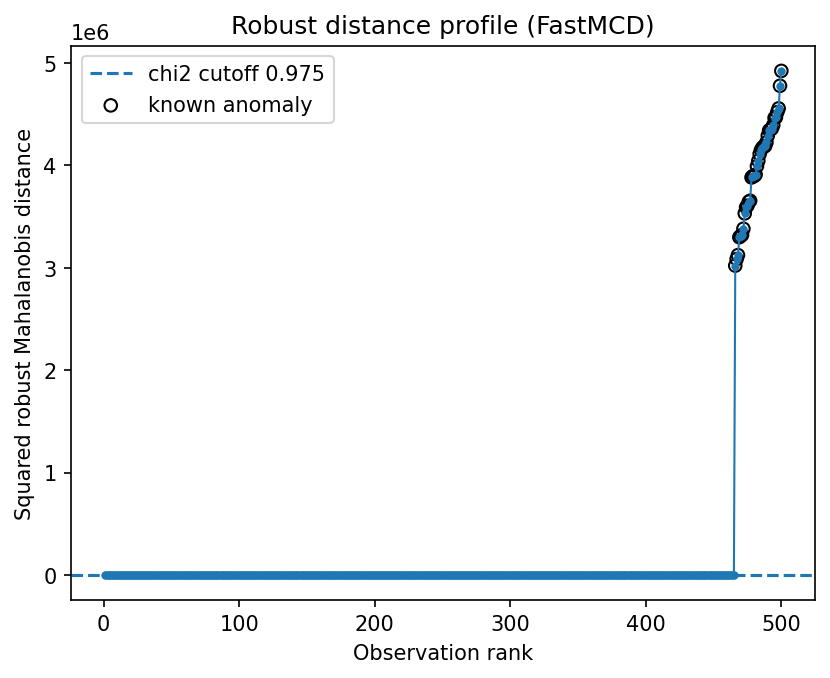
The example recovers all injected abnormal windows. The extremely large radial kurtosis is a useful warning: the distribution is far from Gaussian, so empirical or review-budget thresholds are safer than textbook chi-square thresholds.
What the data represent
The simulation converts signal windows into a vector of summary features. A small number of windows are perturbed to mimic abnormal morphology or measurement artifacts.
Why this estimator
FastMCD is used for the central clean-window population. Regularized heavy-tail estimators are good alternatives when the clean signal itself is very heavy-tailed.
Reproduce the result
python examples/use_case_biomedical_signal.py
Output from the run
biomedical/signal-window anomaly example
features=16, precision=1.000, recall=1.000, detected=35
radial_kurtosis=3031935997.323
saved diagnostics to results/use_cases/biomedical_signal
Figures and diagnostics
How to read the result
The distance profile is the first diagnostic to inspect. A small set of windows should appear clearly above the central bulk. When radial kurtosis is enormous, focus on ranking and visual inspection rather than parametric p-values.
What this does not prove
Medical or biomedical screening requires domain validation. robustcov can prioritize windows for review, but it does not provide clinical labels.