External and Kaggle gallery
This page is the single entry point for optional Kaggle and external-data examples. These examples are not part of tests because they require manual downloads, dataset-specific licenses, or larger local files.
The goal is not to claim that robustcov wins everywhere. The goal is to
show where robust covariance gives a strong advantage, where it is competitive,
where it is mainly diagnostic, and where another method is better.
How to read the cards
Label |
Meaning |
|---|---|
Strong win |
robustcov clearly improves the most relevant metric against common unsupervised baselines. |
Competitive |
robustcov is close to the best method, or wins one metric but loses another. |
Competitive, slow |
robustcov improves quality but runtime is currently a weakness. |
Not best |
another baseline performs better; the robustcov result is still reported for transparency. |
Diagnostic |
there are no ground-truth labels, but robust distances provide interpretable stress/anomaly rankings. |
Recommended result pages
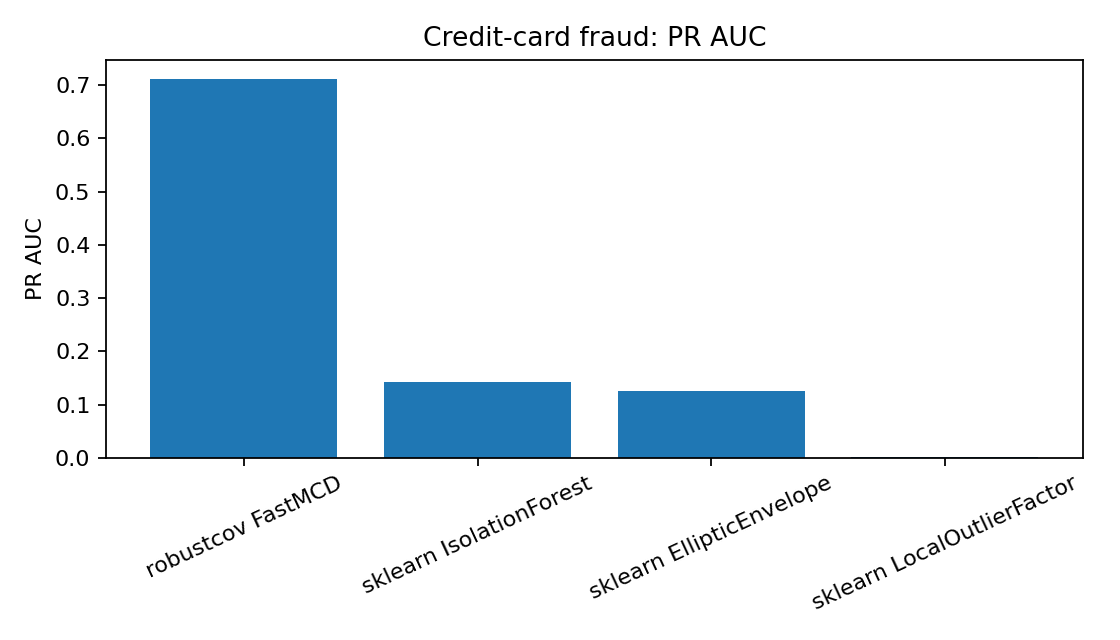
Credit-card fraud
Strong win. FastMCD PR-AUC 0.712 and F1 0.801 on a classic imbalanced fraud dataset.
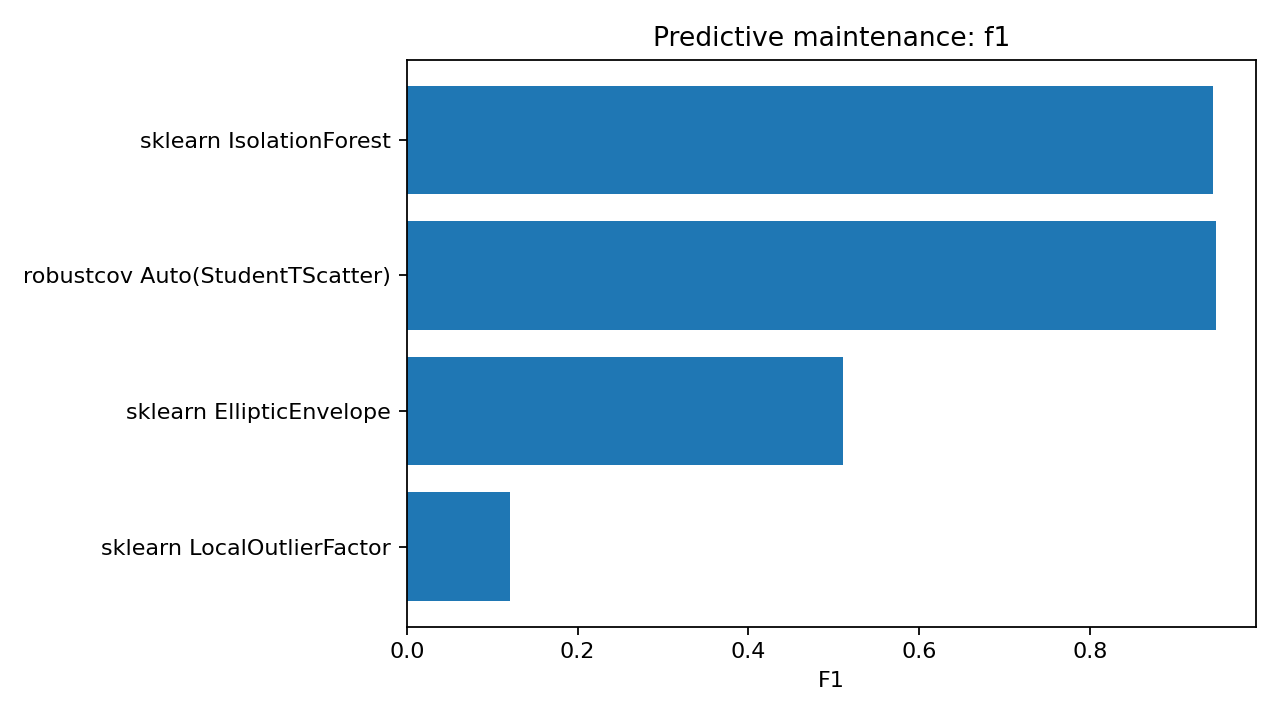
Predictive maintenance
Competitive. robustcov gives the best F1, while IsolationForest has stronger PR-AUC and speed.
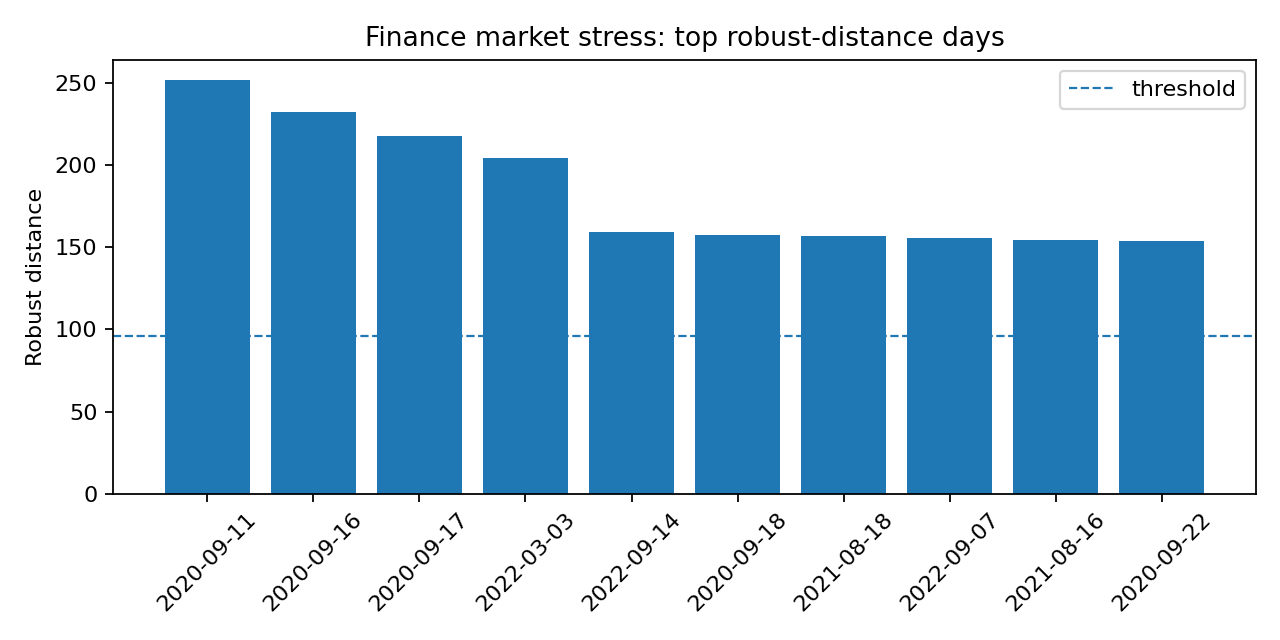
Finance market stress
Diagnostic. RegularizedCauchy ranks unusual cross-asset return days.
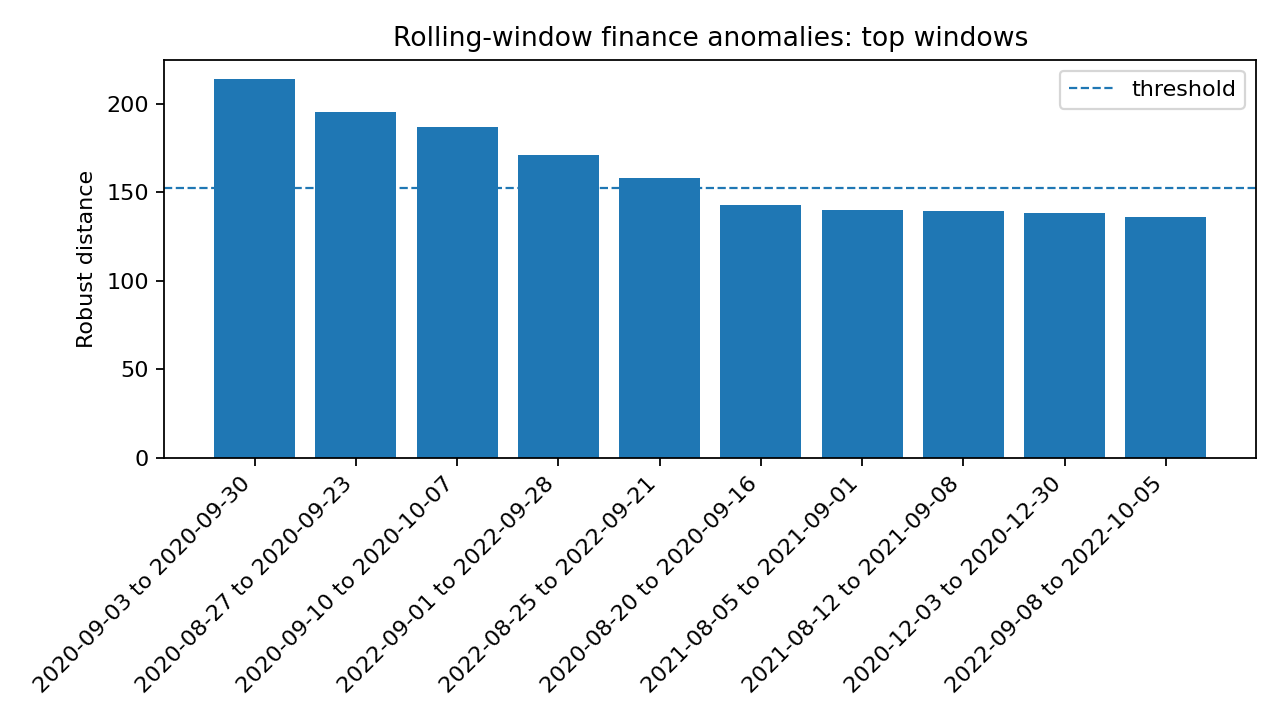
Rolling market regimes
Diagnostic. Window-level features identify abnormal volatility/correlation regimes.
Honest secondary results
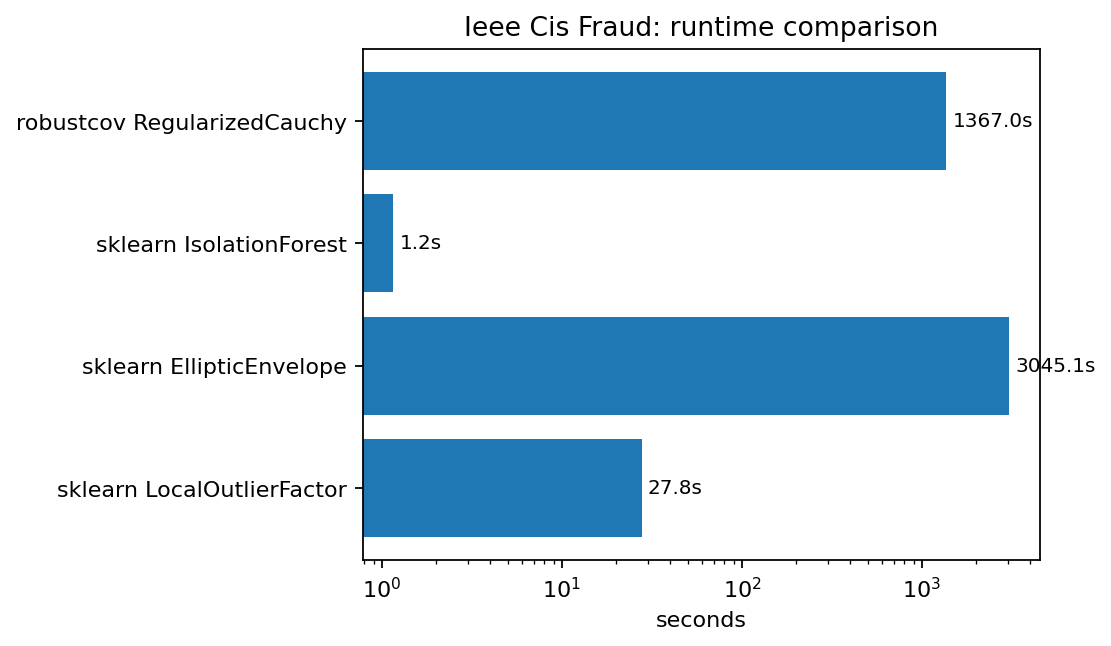
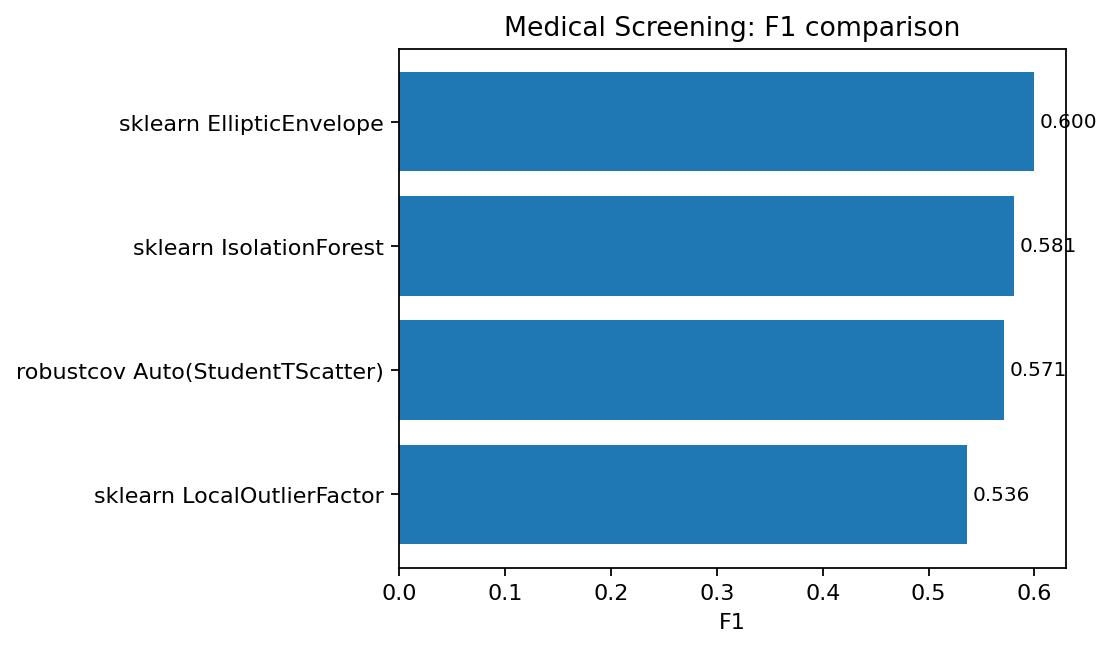
Current documented external results
Dataset / example |
Status |
Main method |
Headline result |
Notes |
|---|---|---|---|---|
Credit-card fraud |
Strong win |
FastMCD |
PR-AUC 0.712, F1 0.801 |
Large metric gap vs common sklearn anomaly baselines. |
Predictive maintenance |
Competitive |
Auto(StudentTScatter) |
F1 0.947 vs IsolationForest 0.944 |
IsolationForest is faster and has better PR-AUC. |
IEEE-CIS fraud |
Competitive, slow |
RegularizedCauchy |
PR-AUC 0.093 vs IsolationForest 0.084 |
Best tested unsupervised quality, but much slower. |
Medical screening |
Not best |
Auto(StudentTScatter) |
PR-AUC 0.567 vs EllipticEnvelope 0.629 |
Honest negative/diagnostic result. |
Finance market stress |
Diagnostic |
RegularizedCauchy |
23 / 899 days detected |
Top days cluster around stress-like periods. |
Rolling-window finance |
Diagnostic |
RegularizedCauchy |
5 / 176 windows detected |
Top windows cluster around September stress regimes. |
Why UNSW-NB15 is not highlighted
The commonly used UNSW-NB15 training split can contain a very high attack
fraction. That makes it less like rare-anomaly detection and more like
unsupervised or semi-supervised classification. robustcov may still be
useful there as a risk-ranking diagnostic, but it is not a clean headline
anomaly benchmark for this package. We therefore do not highlight it in the
external gallery.
Run external examples
External examples are optional and dataset-dependent. The recommended path is:
python examples_external/<script>.py --data path/to/data.csv --outdir results/external/<name>
python examples_external/collect_external_results.py \
  --root results/external \
  --outdir results/external_registry
The scripts, dataset notes, and notebook templates live under examples_external/.
They are intentionally outside the core test suite because Kaggle datasets have
separate licenses, download steps, and file sizes.