Robust GP kernel / input metric
This example shows how robust covariance estimators from robustcov can be
used as input-space metrics for Gaussian-process kernels.
robustcov does not implement Gaussian-process regression, kernel ridge
regression, likelihoods, posterior inference, Bayesian optimization, or training
loops. The GP library owns those pieces. robustcov only supplies robust
input-space covariance geometry.
Result at a glance
The contaminated design points inflate the ordinary empirical input covariance. A GP kernel based on that non-robust geometry can oversmooth along an important input direction. The robust input metric is less distorted.
What the data represent
The synthetic training set has two input features. The response depends mostly on the second feature. A small number of contaminated rows are placed far away in that same direction with unrelated responses.
Why this estimator
FastMCD is used because this is a low-dimensional contaminated-design
example with separable leverage points. The resulting robust precision matrix
is passed into a scikit-learn-compatible Mahalanobis RBF kernel.
Reproduce the result
python examples/gp_robust_input_metric.py
Output from the run
robust GP kernel input-metric example
gp_empirical_input_covariance_rmse=0.3566
gp_robust_input_covariance_rmse=0.1813
empirical_covariance_diag= [0.6417 1.8476]
robust_covariance_diag=    [0.5296 0.0273]
saved diagnostics to results/use_cases/gp_robust_input_metric
Figures and diagnostics
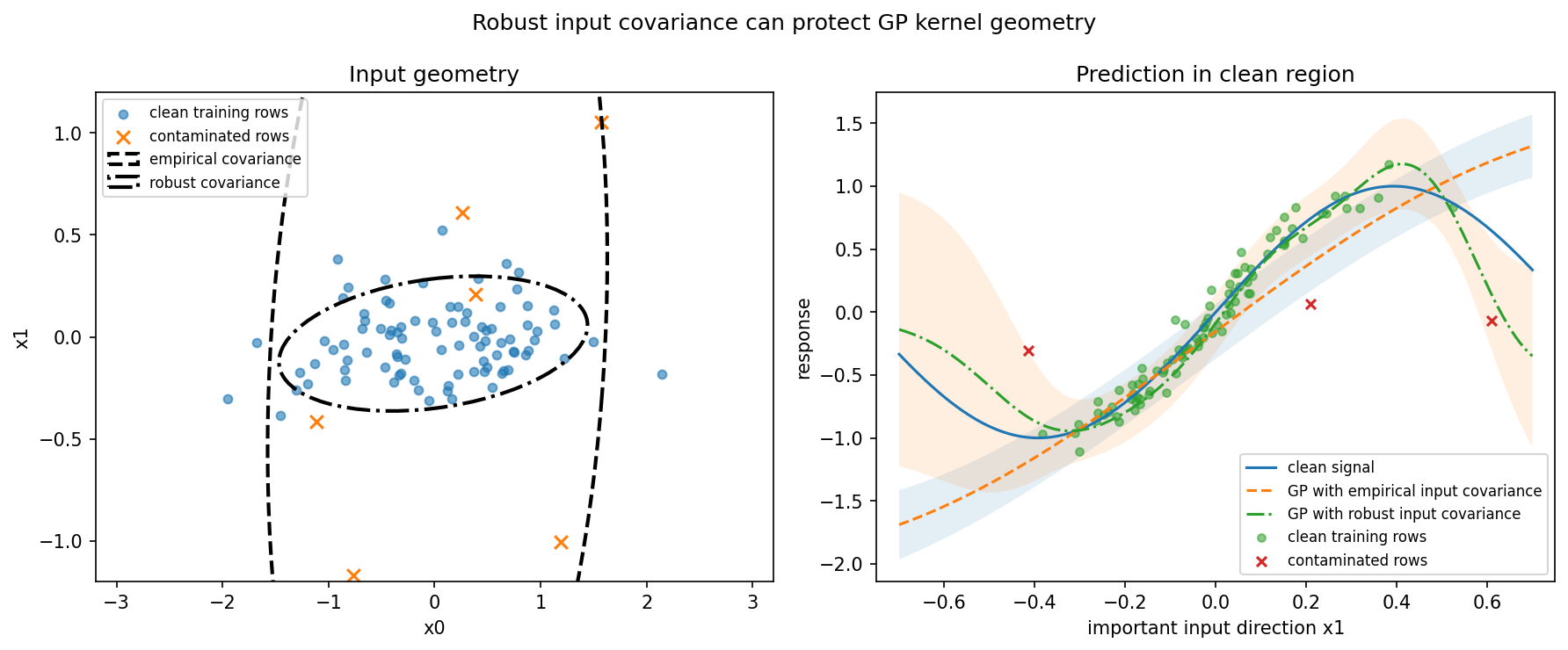
How to read the result
Compare the empirical-kernel GP curve with the robust-kernel GP curve. The GP model and training machinery are the same; only the input-space covariance geometry changes.
What this does not prove
This is not a robust GP likelihood and it does not make the model robust to
outliers in y. Output-side robustness belongs to the GP library through
likelihoods, noise models, or inference choices.